

Hawaiʻi Health Data Warehouse

America’s Health Rankings 2023 Annual Report

The 2023 Annual Report from America’s Health Rankings, released in collaboration with the American Public Health Association, is dedicated to informing and catalyzing actions that promote healthier communities across the United States. The overarching goal of the America’s Health Rankings Annual Report is to improve population health by presenting a holistic perspective of health, establishing state-level benchmarks, highlighting disparities, and prompting action. The report highlights the rise in chronic conditions, alongside disparities across geographical regions and nearly every demographic group.

This year’s report, based on 87 health metrics categorized into five domains, draws data from 28 distinct sources. Additionally, it offers a comparative analysis of the health status of the United States with that of other Organization for Economic Cooperation and Development (OECD) countries, in three metrics: infant mortality, life expectancy and total health spending.

Hawaiʻi was ranked 6th nationally for overall health in 2023 due to low prevalence of frequent mental distress, low rates of multiple chronic conditions, and low prevalence of avoiding care due to cost. Nevertheless, the report identified some prominent challenges in Hawaiʻi including: high economic hardship index score, low volunteerism rate, high prevalence of insufficient sleep. 

  • From 2018 to 2022, Hawaii saw a 29% increase in mental health providers increasing from 240 to 310 providers per 100,000 people. 
  • There was a 50% increase in diabetes prevalence, increasing from 7.8 in 2012 to 11.7% in 2022. 
  • The cost of housing increased 12% in 1 year from 41.4% in 2021 to 46.3% in 2022.
Aloha+ Challenge 2023 Voluntary Local Review

Health happens where we live, work, play, and worship. Explore the latest updates on Hawaiʻi’s progress towards the United Nations Sustainable Development Goals with the Aloha+ Challenge Scorecards, now featuring data from 2023. If you prefer your data in text form,  you can also check out the 2023 Hawaiʻi Voluntary Local Review of local progress towards sustainability goals. 

Available in both Hawaiian and English, the Review utilizes data from 37 targets and over 280 indicators on the Aloha+ Dashboard, focusing on six priority goals identified by the Aloha+ Challenge. These priority goals include:

The Hawaiʻi Voluntary Local Review was produced by the Hawaiʻi Green Growth UN Local2030 Hub in collaboration with network partners across government, business and civil society sectors. The report covers six years of data on the Aloha+ Challenge, based on metrics co-developed by partners statewide across all four counties and used to track progress through the open-data Aloha+ Dashboard.

Native Hawaiian Data Book 2021

The Native Hawaiian Data Book is a biennial online data book produced by the Office of Hawaiian Affairs (OHA). This data book was first compiled in 1994 as a part of the mission of OHA to identify the physical, sociological, psychological and economic needs of Native Hawaiians. Since then, the data book has been continually updated every two years as a source of comprehensive, up-to-date information on the Native Hawaiian population and programs that serve them. Data on population, housing, labor and employment, income, land, water and air, education, health and vital statistics, human services, crime and legacy are included.

Below are some highlights from the 2021 Databook

  • During the school year 2019-2020, a total of 2,338 degrees were earned by Native Hawaiians through the University of Hawai’i System. 
  • As of June 2020, there were 9,933 Department of Hawaiian Home Lands homestead leases across the state, with 8,427 of them being residential leases, 1,096 being agricultural leases and 410 being pastoral leases. However, an additional 45,869 applications were on the waiting list. 
  • In 2020, water consumption in Honolulu County (46,256 million gallons) was almost twice the water consumption of Hawai’i, Maui and Kaua’i counties combined (24,686 million gallons). 

View the full data book under the Resources tab in Hawai’i Health Matters, or view the website directly by clicking here

2020 PRAMS Data

The Pregnancy Risk Assessment Monitoring System (PRAMS) collects state-specific, population-based data on maternal attitudes and experiences before, during, and shortly after pregnancy in forty-six states. In Hawai’i , PRAMS is conducted by the Hawai’i State Department of Health, Family Health Services Division in collaboration with the Centers for Disease Control and Prevention. It is a combination of written and telephone surveys provided to new mothers to monitor maternal behaviors to determine how to reduce infant deaths, decrease low birth weights and improve the overall health of the population in Hawai’i. The 2020 PRAMS data includes 80 new health indicators with two years of data. Here are some highlights from the 2020 PRAMS

2022 Point in Time Count

The Point in Time Count (PIT Count) is the annual census count of street and sheltered people experiencing homelessness. The PIT Count is sponsored by the US Department of Housing and Urban Development (HUD) and is reported to Congress. The Point in Time Count for Oʻahu (Honolulu county) is conducted and reported by Partners in Care – Oʻahu Continuum of Care and the Homeless Point in Time Count for Hawai‘i, Kaua’i, and Maui counties are conducted by Bridging The Gap Continuum of Care (BTG) and reported by Ka Mana O Na Helu.  The two reports are important resources that help establish federal funding to the local community. This year’s PIT Count is particularly important as the 2021 Count was canceled due to COVID-19. 

Here are some facts from the 2022 PIT Count: 

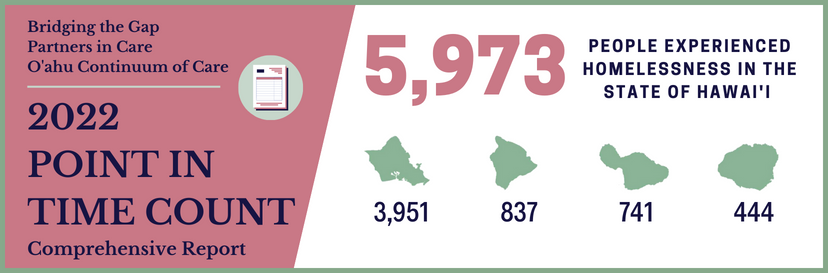
  • A total of 5,973 people experienced homelessness in the state of Hawai‘i. The majority (3,951) of the people were on O’ahu, followed by Hawai‘i (837), Maui (741), and Kaua’i county (444). 
  • There was an 11% decrease in the total number of people who experienced homelessness on O’ahu between 2020 and 2022 (0.4% increase in unsheltered count and 24% decrease in sheltered count). 
  • Between 2020 and 2022, Kaua’i and Hawai‘i counties experienced a 5% increase in homelessness while Maui county experienced a 6% decrease. 
  • Chronic homelessness increased by 18% compared to 2022, raising the number of homeless individuals demonstrating chronicity to 745. By comparison, the average increase in chronic homelessness is 9%. 

2020 BRFSS Data

The Hawaiʻi Behavioral Risk Factor Surveillance System (BRFSS) is an annual telephone survey of over 7,700 adults. We’ve have added close to 40 new health indicators, including modules on adverse childhood events, experiences of cancer survivors, and ocean-based physical activity, and additional indicators on a variety of topics. Here are some highlights from the 2020 BRFSS data: 

  • 7.6% of adults (100,900 residents) have ever been diagnosed with any type of cancer. This includes 6.7% of men and 8.4% of women (age-adjusted rate) in 2020, and ranged from 3.1% of Filipinos to 13.8% of Caucasians.
  • When skin cancer is excluded, 4.7% of adults (63,600 residents) have ever been diagnosed with cancer, not skin, age-adjusted, including 3.6% of men and 5.7% of women in 2020. Cancer diagnosis varied by race/ethnicity from 3.5% among Other Pacific Islanders to 7.3% among Native Alaskan/American Indian and 5.8% among Native Hawaiians.

2020 Death Record Data in Hawaii-IBIS

The 2020 Death Record data is now available in Hawaii-IBIS. Death record data are composed of variables extracted from death certificates based on deaths that occur in the State of Hawai‘i as captured by the Hawai‘i State Department of Health, Office of Health Status Monitoring (OHSM). Death certificates contain important information about the person who died and the date, time, location and cause of death. Cause(s) of death are determined by a physician, advanced practice registered nurse, medical examiner or coroner, and are coded and processed in accordance with International Classification of Diseases, 10th Revision (ICD-10).

The population estimates used for population-based death rates come from the U.S. Census. Currently HHDW has loaded the Vintage 2020 estimates, which are based on the 2010 Census since the 2020 results haven’t been released. Once the 2020 Census results are available, the population estimate file will be updated. Note that death rates may differ slightly once the population estimates are updated later this year.

Below are some highlights from 2020:

2020 Birth Record Data in Hawaii-IBIS

The 2020 Birth Record data is now available in Hawaii-IBIS! The Birth Record data is composed of variables extracted from birth certificates of live births as captured by the Hawai‘i State Department of Health, Office of Health Status Monitoring (OHSM). It provides information about the birth, the infant and the parents. HHDW has loaded the vintage 2020 Census estimates, which are based on the 2010 Census since the 2020 results haven’t been released. Once the 2020 Census results are available, the population estimate file will be updated.

Below are some highlights:

  • There were 15,807 births in 2020, the fewest number of births in past 20 years. The crude birth rate was 11.2 per 1000 persons in 2020, compared to a high of 15.0 per 1000 in 2008.
  • The teen birth rate continues to decline from 17.5 per 1000 girls age 15-19 in 2018 to 13.1 per 1000 in 2020. However, disparities exist by race/ethnicity with 41.9 births per 1000 among Other Pacific Islander teens and 18.9 among Native Hawaiians compared to 8.7 and 6.6 among Caucasians and Filipinos, respectively.
  • In 2020, 11.3% of births received late (3rd trimester) or no prenatal care. Late or no prenatal care varied significantly by county from 4.4% in Maui and 6.6% in Kauai to 10.4% in Hawai‘i and 12.6% in Honolulu Counties.
  • Fertility rate has declined steadily for all DOH Race/Ethnicities over the last five years. In 2020, average fertility rate for all race/ethnicities was 59 per 1000, compared to 67 per 1000 in 2016.

America’s Health Rankings 2021 Annual Report – Cardiovascular Disease

Cardiovascular disease refers to several heart conditions resulting from plaque building up in the arteries, including coronary artery disease, chest pain, heart attacks and stroke. Complications from heart disease can include paralysis, speech difficulties, depression and difficulty engaging in physical activity. The Annual Report produced by America’s Health Rankings collects data to assess the health outcomes on a state-by-state basis and is the longest running assessment of the nation’s health. Hawaiʻi ranked third in the nation for cardiovascular health. Below are some of the findings for cardiovascular disease in Hawaiʻi mentioned in the 2021 Annual Report:

  • 6.6% of Native Hawaiians and Pacific Islanders were diagnosed with cardiovascular disease in 2020, compared to the national average of 8.1% in the United States.
  • The prevalence of cardiovascular disease in Hawaiʻi was two times higher in adults who did not complete a high school degree compared to adults who graduated college (11.8% and 5.4%, respectively).
  • Adults ages 65 and older were more likely to develop cardiovascular disease. 15% of adults ages 65+ compared to 6.2% of adults ages 45-64 and 1.4% for adults ages 18-44 in Hawaiʻi.
  • In Hawaiʻi, cardiovascular disease is more prevalent among men than women. 7.6% of men compared to 4.8% of women.
  • The prevalence of cardiovascular disease in Hawaiʻi was two times higher in adults who did not complete a high school degree compared to adults who graduated college (11.8% and 5.4%, respectively).
  • Adults ages 65 and older were more likely to develop cardiovascular disease. 15% of adults ages 65+ compared to 6.2% of adults ages 45-64 and 1.4% for adults ages 18-44 in Hawaiʻi.
  • In Hawaiʻi, cardiovascular disease is more prevalent among men than women. 7.6% of men compared to 4.8% of women.

You can review the report here.

2021 State of Lung Cancer

The American Lung Association’s State of Lung Cancer report provides information on the state-specific burden of lung cancer and opportunities to mitigate its prevalence. The 2021 report also examines the lifesaving potential of lung cancer screening, which can detect the disease at an earlier stage when it is more curable, and the importance of lung cancer research advancements for better treatment options. The following measures of lung cancer burden are considered in this report: new cases, survival, early diagnosis, surgical treatment, lack of treatment, screening and prevention, racial disparities and Medicaid fee-for-service program coverage of screening.

You can find the full 2021 report and Hawai‘i State Data Infographic in the resource library in HHM, or visit the American Lung Association (ALA) State of Lung Cancer website. If you would like to go directly to the Hawai‘i report on the ALA website, click here.

American Lung Association State of Lung Cancer 2021